Why are integrated solar street lights becoming more popular? The answer is visible on many roads, campuses, parks, and village lanes. A single compact unit combines the solar panel, battery, LED lamp, controller, and housing. This design removes long underground cables and reduces dependence on grid electricity.
Francesco La Camera, Director-General of the International Renewable Energy Agency, has stated, “Solar PV is the cheapest source of electricity in most markets today.” His observation helps explain the growing interest in solar lighting. Falling panel prices, efficient LEDs, and improved lithium batteries have made autonomous street lights more practical. At dusk, the panel’s stored energy powers a bright beam across a pathway. During the day, it quietly recharges.
The strongest appeal is not simply lower energy consumption. Integrated systems can serve remote roads where grid expansion is expensive or slow. Installation may also disturb less soil because fewer cables are required. Municipal teams can monitor some models remotely, checking battery health and lighting performance before failures become obvious.
Still, the technology is not perfect. Shaded locations, dust, weak winter sunlight, and poor battery sizing can reduce reliability. A cheap product may look attractive but perform badly after several seasons. That detail matters.
China’s large manufacturing base has accelerated product variety and price competition. Yet responsible buyers should examine lumen output, battery chemistry, autonomy days, corrosion protection, warranty terms, and local maintenance support. Popularity should follow performance, not marketing alone. The best integrated solar street light is the one that keeps working when conditions become difficult.
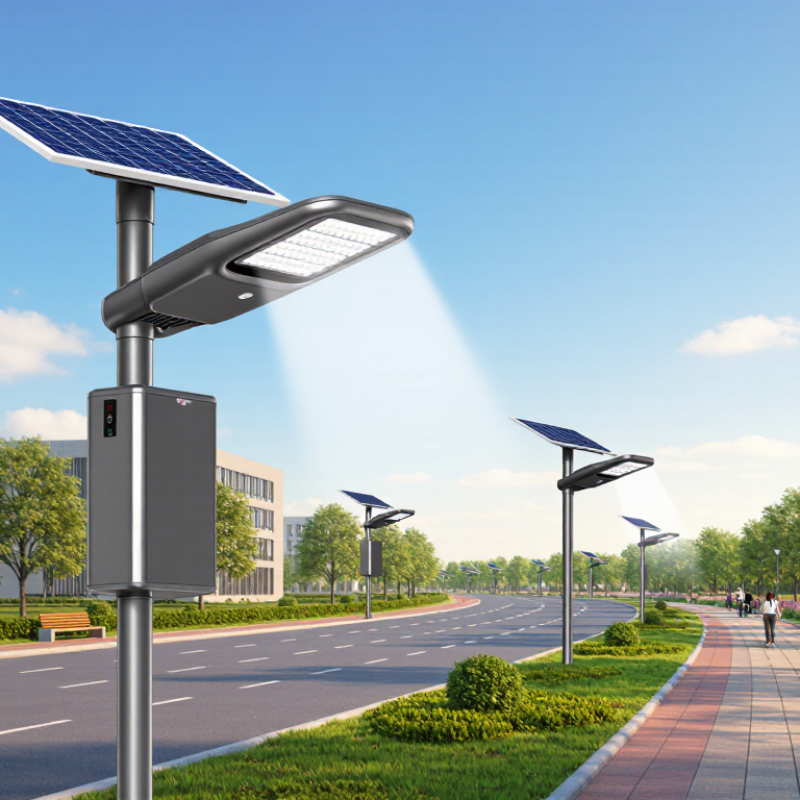
China’s top integrated solar street lights are popular because they combine several outdoor lighting parts in one compact unit. The solar panel, lithium battery, LED lamp, controller, and motion sensor share one weather-resistant housing. During daylight, the panel converts sunlight into electricity and stores it in the battery. At dusk, a light sensor starts the LED automatically.
Many models use smart dimming. The lamp may operate at full brightness near a road junction, then reduce output when traffic is low. Motion detection can raise brightness when pedestrians or vehicles approach. This design reduces wiring, excavation, and maintenance points. In practical projects, installation can be faster than building a separate panel, battery cabinet, and lamp system. However, “integrated” does not mean maintenance-free. Battery aging, shading, dust, and long cloudy periods still affect performance. A poorly sized system may look bright for two nights and fail later.
Tips: Check local sunlight data before choosing panel and battery capacity. Confirm the battery’s operating temperature range, protection rating, and expected cycle life. For coastal or dusty areas, inspect sealing and corrosion resistance carefully. Match the LED distribution to the road width, not only its advertised wattage. A common mistake is placing lights under trees or beside tall buildings. Even efficient equipment cannot charge well in deep shade. Certified testing, accurate photometric data, and professional installation make the system more dependable. Some projects still need grid backup, especially in regions with extended winter clouds.
| Data Dimension | Typical Information | Why It Matters |
|---|---|---|
| System Definition | A self-contained outdoor lighting system that combines the solar panel, LED lamp, rechargeable battery, controller, and housing in one integrated unit. | Fewer external components can simplify installation, wiring, and routine maintenance. |
| Energy Source | Solar photovoltaic energy converted into electricity during daylight hours. | The system can operate without a continuous connection to the utility grid. |
| Typical LED Power Range | Approximately 20–100 W for many residential roads, pathways, parking areas, and local streets. | The required power depends on road width, pole spacing, mounting height, light level, and optical design. |
| LED Luminous Efficacy | Modern outdoor LED modules commonly provide roughly 120–190 lumens per watt at the fixture level, depending on design and operating conditions. | Higher efficacy can provide the required illumination with lower electrical demand. |
| Solar Panel Capacity | Common systems use approximately 40–200 Wp of photovoltaic capacity, selected according to location and load. | Panel sizing must account for local solar irradiation, seasonal variation, shading, and system losses. |
| Battery Technology | Lithium-ion and lithium iron phosphate batteries are widely used; lead-acid batteries are also found in some designs. | Battery chemistry affects usable capacity, weight, temperature performance, service life, and replacement cost. |
| Typical Battery Voltage | Many small and medium systems use nominal battery voltages of approximately 12 V or 24 V. | Voltage selection must match the LED driver, controller, battery pack, and panel configuration. |
| Operating Schedule | Usually dusk-to-dawn operation with programmable dimming, such as full output during peak hours and reduced output later at night. | Adaptive lighting can reduce energy consumption while maintaining useful nighttime visibility. |
| Autonomy | Approximately 2–5 nights is a common design target, although actual autonomy varies with battery size, lighting profile, climate, and required reliability. | Additional autonomy helps maintain lighting during cloudy or rainy periods but increases system size and cost. |
| Charging and Control | A charge controller regulates photovoltaic charging, prevents damaging overcharge or deep discharge, and controls the LED load. | Proper power management improves battery protection and overall operating stability. |
| Light Control Method | Photocells, programmable timers, motion sensors, or centralized wireless controls may be used. | Control strategies help match lighting output to traffic patterns and available stored energy. |
| Weather Protection | Outdoor units are commonly designed with sealed housings and ingress protection ratings such as IP65 or higher. | Protection against dust and water is important for reliable outdoor operation. |
| Expected LED Service Life | Quality LED modules are often rated for up to 50,000–100,000 operating hours under specified thermal conditions. | Actual performance depends on heat management, driver quality, operating temperature, and LED current. |
| Installation Requirements | Installation generally requires a pole, foundation, mechanical fasteners, correct orientation, and sufficient exposure to direct sunlight. | Correct positioning helps improve solar charging and lighting coverage. |
| Grid Connection | Normally not required for standard standalone operation. | This is useful for remote roads, rural areas, parks, construction sites, and locations where grid extension is expensive. |
| Main Environmental Benefit | Uses renewable solar energy and can reduce electricity drawn from fossil-fuel-based grids. | The environmental benefit depends on product durability, battery replacement, recycling, and local solar conditions. |
| Key Selection Factors | Solar resource, latitude, shading, road classification, lighting requirements, battery capacity, wind load, ambient temperature, maintenance access, and local regulations. | A properly sized system is more dependable and cost-effective than choosing equipment based only on nominal wattage. |
Note: The figures shown are representative industry ranges for general planning. Actual specifications and performance vary according to project design, climate, component quality, and installation conditions.
It combines the solar panel, battery, LED module, controller, and housing in one unit. Fewer cables simplify installation.
Buyers often find wider component choices, faster prototypes, and competitive quotations. One supplier can coordinate the complete lighting system.
Lithium iron phosphate batteries are often preferred for repeated cycling and hot summer conditions. Battery quality still varies.
Yes. Clouds, dust, winter shade, and poor panel angles can reduce energy production. Local testing matters more than brochures.
Check LED efficiency, optical distribution, motion sensing, and actual illumination data. Advertised wattage alone is insufficient.
Request photometric reports, protection ratings, battery-cycle data, and salt-spray test results. Ask for winter performance evidence too.
No. A dashboard can misread sensors or hide gradual battery decline. Physical inspections remain necessary.
Check the solar resource, mounting angle, battery capacity, pole height, and autonomy days. Rainy-night testing can reveal weak designs.
Yes. Buyers may request taller poles, lower brightness near homes, or motion dimming on quiet roads. Customization can increase cost.
Not always. A cheaper system may contain a smaller battery or optimistic autonomy claims. Replacement costs can become unpleasant.
Integrated solar street lights combine the solar panel, battery, LED lamp, controller, and other key components in one compact unit. During the day, the panel converts sunlight into electricity and stores it in the battery; at night, the stored energy powers the LED light automatically. Why are integrated solar street lights becoming more popular? Their cable-free design, simple installation, energy efficiency, and suitability for areas with limited grid access make them an attractive solution for roads, parks, communities, and public facilities.
China’s top integrated solar street lights are valued for practical features such as high-efficiency solar panels, long-lasting batteries, intelligent lighting control, motion-sensing options, weather-resistant housing, and flexible operating modes. Buyers often consider Chinese solutions because they can offer competitive pricing, broad product selection, scalable manufacturing, and convenient customization. When comparing products, purchasers should evaluate lighting performance, battery capacity, operating life, materials, warranty support, certifications, and total ownership cost rather than focusing only on the initial price. Selecting a reliable manufacturer with consistent quality control is essential for achieving durable and cost-effective results.

 NexLt Light