How long do solar street light batteries actually last? The honest answer depends on battery chemistry, operating conditions, and system design—not simply where the light was manufactured. Many solar street lights use lithium iron phosphate batteries, which may serve for roughly five to ten years under suitable conditions. Lead-acid batteries often need replacement sooner, sometimes after two to five years. These are broad estimates, not guarantees. A supplier’s cycle-life figure can help, but it does not tell the whole story.
Consider a light that runs through long winter nights, then faces several cloudy days. Repeated deep discharges, high temperatures inside the battery enclosure, and incorrect charging settings can shorten service life. A well-sized panel and battery can reduce strain. Ask the manufacturer for the battery chemistry, rated capacity, cycle-life conditions, warranty terms, and replacement availability. Check whether test figures assume a particular discharge depth and temperature. Small print matters.
Watch the installation, too.
A datasheet may show thousands of cycles, yet real performance depends on the site and maintenance. Dust on panels, loose connections, or a battery exposed to harsh heat can undermine an otherwise solid product. For lights sourced from China, compare the specific battery specification and test documentation rather than relying on country-of-origin claims. Even then, estimates remain imperfect. A realistic service-life plan should include inspection and eventual replacement, not assume the battery will keep working indefinitely.
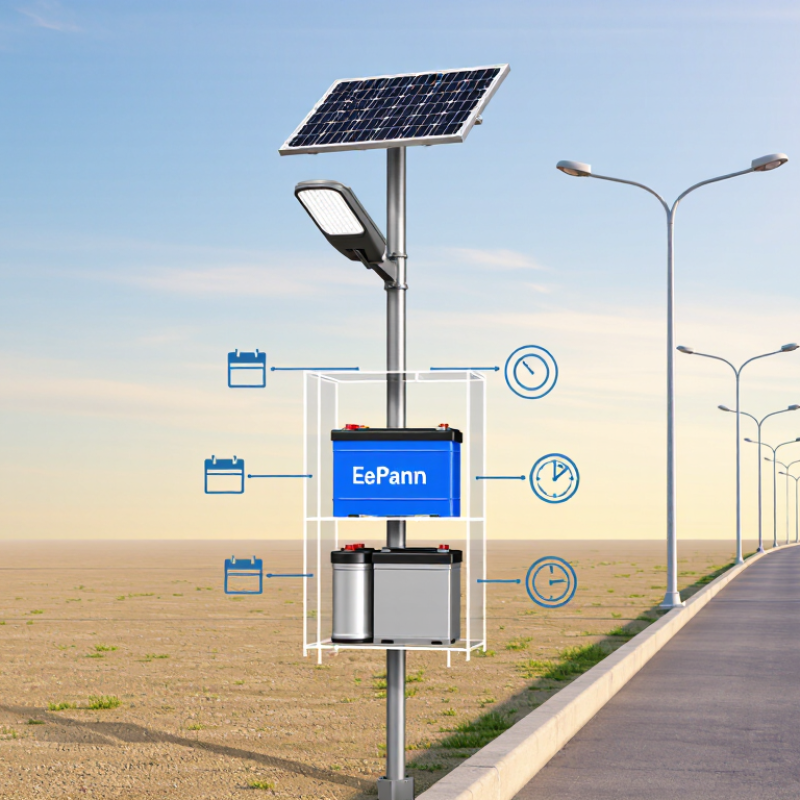
Typical Lifespan of Solar Street Light Batteries Made in China
How Long Do Solar Street Light Batteries Last from China?
Typical Lifespan of Solar Street Light Batteries Made in China
Battery life depends more on chemistry, temperature, and charge control than on country of manufacture. For project planning, sealed lead-acid batteries often need replacement after about 2–4 years. Lithium iron phosphate batteries commonly provide around 5–8 years under suitable conditions. These are practical estimates, not guarantees. Not a promise.
IRENA’s 2017 report, Electricity Storage and Renewables: Costs and Markets to 2030, gives broad technical lifetime ranges of roughly 5–15 years for several battery types. NREL’s 2024 Annual Technology Baseline models a 15-year life for utility-scale battery storage. That figure is a useful benchmark, but it does not predict the life of a compact streetlight battery exposed outdoors.
Heat can shorten service life. So can deep nightly discharge, cloudy stretches, and a poorly matched solar panel. Check the battery datasheet for cycle-life conditions, then compare them with local night-time loads and temperatures. A shaded battery enclosure helps, but real sites rarely match laboratory conditions exactly. Even careful estimates need revisiting after the first seasons.
Battery Types and Their Expected Service Life
Battery chemistry largely determines how often a solar street light needs a replacement. Sealed lead-acid batteries often provide about 2–4 years in outdoor lighting, while lithium iron phosphate batteries commonly last around 5–8 years under suitable conditions. These are planning ranges, not guarantees. Heat, deep nightly discharge, and prolonged undercharging can shorten either battery’s service life.
NREL’s 2024 Annual Technology Baseline uses a 15-year lifetime assumption for utility-scale lithium-ion storage. That figure is a modeling benchmark, not a street-light battery promise: small batteries face different temperatures, charging patterns, and maintenance. In practice, check the battery datasheet for rated cycles at a stated depth of discharge. A “5,000-cycle” rating means little without those test conditions. A hot battery box under a metal pole can age faster than the same chemistry in a shaded, ventilated enclosure.
Tips: Ask the supplier for cycle-life data at the expected discharge depth, operating temperature, and charge rate. Compare the warranty with the rated service life. For a simple field check, record nighttime dimming and morning battery voltage across several weeks. It is not a perfect test, but it can reveal trouble early.
How Long Do Solar Street Light Batteries Last from China? - Battery Types and Their Expected Service Life
| Battery type |
Typical cycle life* |
Typical service life in street-light use |
Practical considerations |
| Lithium iron phosphate (LiFePO₄) |
About 2,000–5,000 cycles |
About 5–10 years |
Often suited to frequent cycling. A compatible battery-management system and protection from extreme heat or cold help extend service life. |
| Lithium-ion (NMC) |
About 1,000–2,000 cycles |
About 3–7 years |
Service life depends strongly on operating temperature, charge control, and depth of discharge; battery protection is essential. |
| Gel lead-acid |
About 500–1,000 cycles |
About 3–5 years |
Sealed construction avoids routine water top-ups, but frequent deep discharge and high temperatures can shorten life. |
| AGM lead-acid |
About 300–700 cycles |
About 2–4 years |
Sealed and maintenance-free, but repeated deep cycling can substantially reduce usable life. |
| Flooded lead-acid |
About 300–500 cycles |
About 2–4 years |
Requires suitable ventilation and periodic maintenance. Spillage risk and maintenance needs may make it less convenient for pole-mounted systems. |
*Cycle-life figures are approximate and vary by cell design, discharge depth, temperature, charging, and the point at which capacity is considered too low for use. Service-life estimates are general planning ranges, not guarantees; they apply to properly sized and maintained systems and are not specific to any manufacturer or country of origin.
Factors That Affect Battery Longevity
How Long Do Solar Street Light Batteries Last from China? Factors That Affect Battery Longevity
Battery life depends on more than its chemistry. IRENA’s 2017 report, Electricity Storage and Renewables: Costs and Markets to 2030, gives lithium-ion storage systems a typical lifetime range of 5–15 years. That is a broad stationary-storage estimate, not a guarantee for a street light exposed to heat, rain, and daily cycling. Heat matters. High cell temperatures can speed up aging, while repeated deep discharge puts extra strain on the battery. Poorly matched panels or charge controllers may also leave it undercharged or overcharged.
Battery sizing is easy to overlook. A light that runs through long winter nights may draw more energy than its battery can safely supply, shortening service life. Moisture around terminals and damaged seals can add corrosion risks. Still, a datasheet number can mislead: real performance depends on local weather, settings, and maintenance. Periodic checks of nighttime runtime, battery voltage, and visible corrosion help identify decline before the light stops working.
Tips: Keep the battery shaded inside a ventilated enclosure, check connections after wet seasons, and avoid routinely draining it to empty. Record runtime through several cloudy nights; one unusually dim evening is not enough to diagnose a failing battery.
Signs of Battery Wear and When to Replace It
Battery wear often appears as shorter night-time operation before the light stops working.
A fixture that once stayed bright until dawn may now dim after midnight, even after several sunny days. That change matters. Compare several nights, because clouds, dust on the panel, and seasonal sunlight can also reduce charging.
Look for repeated symptoms: a battery that needs more time to charge, sudden brightness drops, or poor performance after a full day of sun. In cold weather, some battery types temporarily deliver less power, so one weak night is not enough to prove failure. Check the panel surface, wiring, and light settings first. I have seen maintenance checks focus on the battery while a loose connection was the real cause.
Replacement is worth considering when reduced runtime continues after basic checks and the battery no longer stores enough energy for the site’s usual nights. Record dusk-to-dawn operating hours and compare them over a few weeks. Also inspect for swelling, leakage, unusual heat, or corrosion; stop using a visibly damaged battery and arrange safe service. There is no universal replacement date. Battery chemistry, charge cycles, temperature, and installation quality all affect service life, and field records are not always perfect. A practical decision comes from the trend, not one disappointing evening.
Maintenance Practices That Extend Battery Life
How Long Do Solar Street Light Batteries Last from China?
Maintenance Practices That Extend Battery Life
A solar street light battery may last years less than its rating suggests when heat, deep discharge, and poor charging control combine. The U.S. Department of Energy’s 2022 Grid Energy Storage Technology Cost and Performance Assessment gives lithium-ion batteries a broad benchmark of 2,000–10,000 cycles and 10–20 years of calendar life. That is not a street-light warranty: nightly cycling and hot enclosures can shorten real service life. Small details matter.
Inspect the system every three to six months. Wipe dust from the solar panel, then check for cracked cable insulation, loose terminals, corrosion, and water inside the battery compartment. A clean panel is not a healthy battery. Record overnight dimming or early shutoff; these changes can reveal reduced capacity before complete failure. NREL’s Best Practices for Operation and Maintenance of Photovoltaic and Energy Storage Systems recommends planned inspections and maintenance tailored to equipment and site conditions.
Keep the charge controller settings matched to the battery chemistry, and avoid repeated deep discharges where the controller allows a low-voltage cutoff. Check that the battery box is shaded from direct afternoon sun and can shed heat. Don’t assume a visual check measures capacity; it can miss internal aging. An annual capacity test is more useful, though it takes time and may be overlooked. Keep inspection dates and readings together, so replacement decisions rely on trends rather than guesswork.
How Long Do Solar Street Light Batteries Last from China?
Typical service-life estimates by battery type
Typical estimates are about 2–3 years for lead-acid batteries and 5–8 years for LiFePO₄ batteries. Actual life varies with temperature, depth of discharge, charging conditions, and system design. To help extend battery life, prevent repeated deep discharge, keep the battery within its specified temperature range, and regularly inspect the controller, wiring, connections, and enclosure. Check electrolyte levels only for serviceable flooded lead-acid batteries; sealed batteries should not be opened.
Conclusion
Solar street light batteries made in China can last for several years, but their actual service life depends on battery chemistry, usage, and environmental conditions. How long do solar street light batteries actually last is best answered by considering the battery type: lithium batteries generally offer a longer service life and more charge cycles, while lead-acid options may need replacement sooner. Heat, deep or frequent discharge, inadequate charging, and poor installation can all shorten battery life.
Signs of wear include reduced nighttime runtime, dimmer lighting, slower charging, or inconsistent performance. Regularly cleaning solar panels, keeping connections secure, checking system settings, and preventing prolonged deep discharge can help extend battery life. When these symptoms persist despite basic maintenance, replacing the battery can restore reliable lighting and help the solar street light continue operating efficiently.

 NexLt Light