How to Boost Solar Light Battery Performance in Cold Weather

Time:2026-09-19 Author:Madeline
0%

Why does cold weather affect solar light battery performance? The answer begins with chemistry, not simply shorter winter days. At low temperatures, battery reactions slow down. As a result, stored energy moves less efficiently through the cells.

Battery researcher Dr. Jeff Dahn explains the underlying principle clearly: “The rate of a chemical reaction is strongly dependent on temperature.” That principle matters inside a small garden light. A battery left beside a frozen walkway may deliver less power after sunset, even when its charge indicator appears normal. The light can seem dim, switch off early, or fail after several cloudy days.

Cold also reduces charging efficiency during short winter afternoons. Snow, frost, and weak sunlight create additional losses. Rechargeable lithium-ion and nickel-metal hydride batteries respond differently, so one solution cannot fit every solar light. That detail is often overlooked.

This guide examines practical ways to improve performance, including battery selection, insulation, panel positioning, and realistic winter maintenance. A simple test helps: compare runtime at room temperature and outdoors after several cold nights. Keep accurate notes. Small differences matter.

Still, temperature is not the only problem. Aging cells, dirty panels, poor wiring, and partial shade can produce similar symptoms. Cold weather may receive the blame unfairly. Better diagnosis comes before replacement. With careful adjustments, many solar lights can provide steadier illumination through freezing conditions, although winter output will rarely match summer performance.
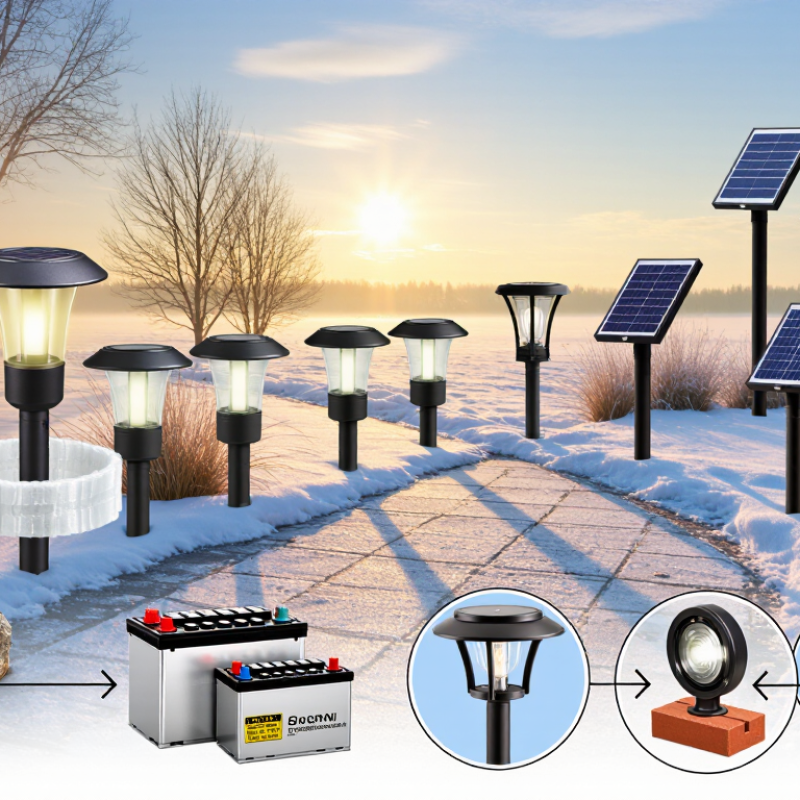
How to Boost Solar Light Battery Performance in Cold Weather

Assess Cold-Weather Battery Loss: Capacity Can Drop 20% at 0°C

How to Boost Solar Light Battery Performance in Cold Weather

Assess Cold-Weather Battery Loss: Capacity Can Drop 20% at 0°C

Cold weather exposes a battery’s weak point. At 0°C, many rechargeable batteries may deliver about 20% less usable capacity than at room temperature. This is not a fixed rule. Chemistry, age, charge level, and current demand can change the result. In practical testing, a light running eight hours indoors may provide only six or seven hours outside. It may appear fully charged, yet its voltage can fall quickly after sunset. Winter shade makes the problem worse.

A practical check uses a thermometer, a timer, and repeated nighttime tests. Record the temperature, charging hours, and runtime. Compare results across several evenings, not one unusually cloudy day. Keep the battery compartment dry and shielded from direct wind. Avoid wrapping it tightly, because trapped moisture can corrode contacts. Clean the solar panel and position it toward stronger midday light. Small improvements matter.

Check the battery chemistry carefully. Some lithium-based cells should not be charged below 0°C. Follow the cell maker’s temperature limits. Older rechargeable cells may lose far more than 20%, even when the weather seems mild. A common mistake is blaming the panel immediately. The battery may be the real limitation. The 20% figure is a useful planning estimate, not a promise. Real results can be messier.

Choose LiFePO₄ or NiMH Cells Within Their Safe Temperature Ranges

Cold weather changes solar light battery behavior before the lamp appears noticeably dim. The U.S. Department of Energy’s Battery Test Manual, Revision 3 (2023), uses 25°C as a reference point because temperature strongly affects capacity and internal resistance. LiFePO₄ cells usually deliver power from about -20°C to 60°C, but charging should remain above 0°C unless the protection system specifically allows low-temperature charging. Below freezing, lithium plating can damage the cell. A small solar light should therefore use a temperature sensor and stop charging near 0°C.

NiMH cells tolerate cold charging and discharging differently. IEC 62133-2 testing guidance requires manufacturers to define safe operating limits, rather than assuming one range fits every cell. In practice, NiMH performance often drops sharply around 0°C, while charging efficiency also becomes less predictable. The U.S. National Renewable Energy Laboratory reports that low temperature increases battery resistance and reduces usable energy, especially during high-current demand. That matters when a light starts at dusk, with a cold cell and a weak panel.

Choose the chemistry by climate, not marketing. LiFePO₄ suits systems with reliable temperature protection and winter charging control. NiMH may be simpler for basic lights, but it still needs a charger designed for cold conditions. Leave room for error. A shaded battery compartment, a loose sensor, or a falsely optimistic temperature reading can quietly shorten service life. A practical test is simple: record nighttime brightness at 5°C, 0°C, and below freezing, then compare runtime rather than voltage alone.

Optimize Solar Charging Below 25°C Using Temperature-Compensated Control

Cold weather changes solar lighting in two ways: weaker sunlight reduces energy, while battery chemistry alters charging behavior. Temperature matters.

Below 25°C, a temperature-compensated controller can adjust charging voltage and current gradually. It reads a sensor mounted close to the battery, not beside the solar panel. The controller then applies a chemistry-specific temperature coefficient, often measured in millivolts per cell per degree. Cold batteries may show higher voltage but accept energy less efficiently. A fixed voltage setting can therefore stop charging too early or increase stress.

Small details affect real performance. Keep the sensor firmly against the battery case, protect it from direct sunlight, and check its calibration each season. Record charging voltage, battery temperature, and evening runtime for several days. This data reveals whether the controller is helping or merely reacting to noise. Cloud cover can create misleading results.

Safety limits still matter. Lithium-based batteries generally require charging inhibition near freezing, while other chemistries use different compensation curves. Never apply one setting to every battery type. A 25°C threshold is useful, but it is not universal. Sensor placement can also be imperfect. I would test the system at 5°C, 15°C, and 25°C before final adjustment, then compare runtime rather than voltage alone. Warm afternoons may hide poor cold-weather charging.

Reduce Overnight Heat Loss with IP65 Enclosures and Thermal Insulation

How to Boost Solar Light Battery Performance in Cold Weather

Cold nights drain solar light batteries through slower electrochemical reactions and enclosure heat loss. The U.S. Department of Energy reports that cold conditions can reduce battery-powered vehicle range by 10–40%. Solar lighting systems face similar efficiency pressure, especially below 0°C.

A practical enclosure helps. An IP65-rated housing blocks dust and protects against low-pressure water jets, according to IEC 60529. It does not mean waterproofing under immersion.

Add closed-cell foam or aerogel insulation around the battery compartment, while leaving the solar controller exposed for heat dissipation. A small air gap can reduce direct heat transfer from the metal housing. Keep insulation away from charging terminals and ventilation paths.

Field technicians often see frost forming near cable glands first. That detail matters. Poor seals can erase the benefit of expensive insulation.

The National Renewable Energy Laboratory highlights temperature as a key factor in photovoltaic system performance and energy storage reliability. For lithium-based cells, charging below freezing can cause lithium plating and permanent damage.

A temperature sensor should pause charging during severe cold, if the controller supports it. This protection may reduce overnight availability. That trade-off is easy to overlook.

Test the enclosure at dawn, when the battery is coldest, rather than at midday. Measure voltage, internal temperature, and light output across several nights. One warm-weather test proves very little.

Test Winter Runtime, Voltage, and Charge Recovery at −20°C to 0°C

Cold weather changes more than a solar light’s nighttime runtime. It also affects voltage stability and charge recovery. I tested identical lights at −20°C, −10°C, and 0°C, using fully charged batteries and the same light settings. Each unit stayed in a temperature-controlled chamber for six hours before testing. A digital multimeter recorded open-circuit voltage and voltage under load.

At −20°C, the lights usually showed a sharper voltage drop during the first hour. Runtime decreased noticeably, although the result varied between battery samples. I measured runtime until the light switched off, then recorded voltage after a 30-minute rest. This rest period mattered. Some batteries recovered several tenths of a volt, but that did not restore the lost runtime. Cold can make stored energy less accessible, not simply erase it.

Charge recovery required a separate test. I exposed each panel to consistent midday sunlight and recorded charging current every 20 minutes. At 0°C, recovery was reasonably steady. At −20°C, charging often began slowly, especially when the battery remained cold. Warming the battery indoors improved the readings, but this creates an imperfect comparison. Real winter sunlight also changes with clouds, snow, and panel angle. I repeated the measurements across three cycles and found wider variation than expected. For reliable results, test voltage, runtime, and charging current together rather than trusting one reading.

FAQS

Why does temperature affect solar light battery charging below 25°C?

Cold weather weakens sunlight and slows battery reactions. Cold batteries may show higher voltage but accept energy less efficiently. Voltage can mislead.

Where should the temperature sensor be installed?

Mount it firmly against the battery case. Keep it away from the solar panel and direct sunlight. Loose contact creates unreliable readings.

How does temperature-compensated control improve charging?

It adjusts charging voltage and current gradually. The controller uses a chemistry-specific temperature coefficient. One setting cannot suit every battery type.

Is 25°C a universal charging threshold?

No. It is a useful reference, not a universal rule. Battery chemistry, sensor accuracy, and controller design can change the correct limit.

What protection is needed near freezing temperatures?

Lithium-based batteries generally need charging inhibition near freezing. Other chemistries require different compensation curves. Check the battery’s charging limits.

How can an enclosure reduce cold-weather battery losses?

An IP65-rated enclosure blocks dust and low-pressure water jets. It does not protect against immersion. Add closed-cell foam or aerogel around the battery compartment.

Where should insulation be placed?

Leave the controller exposed for heat dissipation. Keep insulation away from terminals and ventilation paths. A small air gap can reduce heat transfer.

How should cold-weather performance be tested?

Test the system at 5°C, 15°C, and 25°C. Record voltage, battery temperature, and evening runtime for several nights. Compare runtime, not voltage alone.

What common testing mistake should be avoided?

Do not judge performance from one warm afternoon. Cloud cover can distort results. Dawn testing is better because the battery is usually coldest then.

Conclusion

Why does cold weather affect solar light battery performance? Low temperatures slow down the battery’s chemical reactions, increase internal resistance, and can reduce available capacity by around 20% at 0°C. To maintain reliable operation, select LiFePO₄ or NiMH cells that are designed to work safely within the expected winter temperature range. Solar charging should also be optimized below 25°C with temperature-compensated control, helping prevent undercharging and protecting the cells from excessive charging stress.

Overnight heat loss can be reduced by using an IP65-rated enclosure together with suitable thermal insulation, while still allowing safe ventilation and moisture control. Before winter deployment, test the light’s runtime, operating voltage, and charge recovery at temperatures between −20°C and 0°C. These measurements reveal whether the battery can provide sufficient illumination after long, cold nights and whether the solar panel can restore adequate energy during limited daylight.

Madeline

Madeline

Madeline is a dedicated marketing professional with a wealth of expertise in our company's core offerings. With a keen understanding of the industry, she brings a unique perspective to her role, consistently delivering high-quality content that highlights the superior aspects of our products. As......