Choosing a flood light is not just a matter of color. It affects visibility, mood, and how clearly people can recognize details outdoors. A warm-white fixture can make a garden path feel calm, while a fixed cool-white beam can reveal steps, gates, and work areas with consistent clarity. RGB models add color effects, but their extra flexibility may not improve everyday visibility.
For readers asking, “How to choose between monochromatic and RGB flood lights,” the answer starts with the job the light must do. Lighting designer Randall Whitehead’s work emphasizes matching light to a space and its purpose; a practical way to express that principle is: “Choose the light for the task first, then consider the effect.” This is a paraphrase, not a verified direct quotation. Compare beam angle, brightness, weather resistance, controls, and replacement options before focusing on color features.
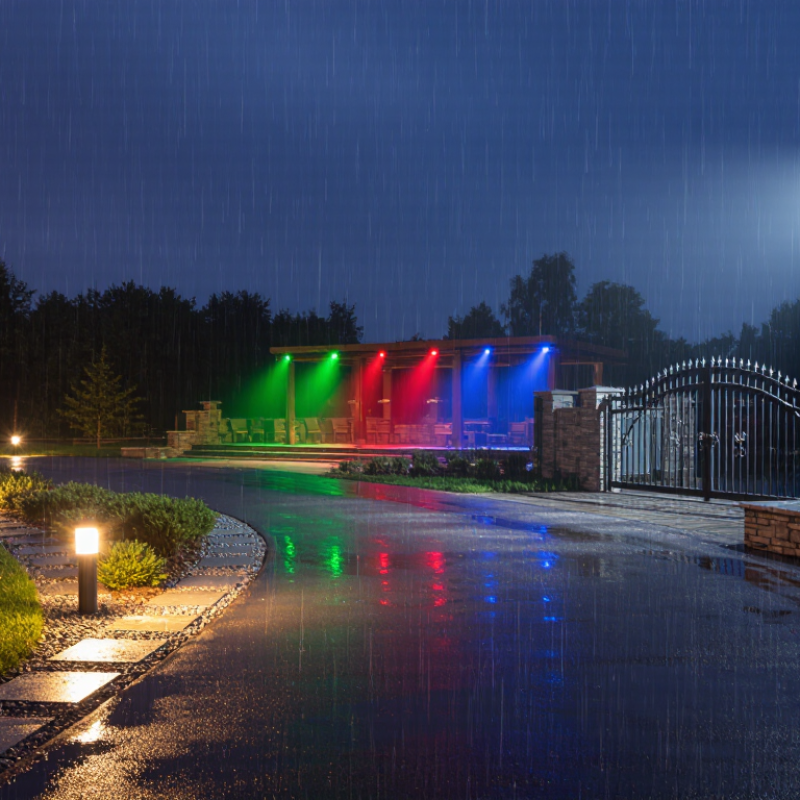
Think about a driveway on a rainy evening, or a patio where color changes are used only during gatherings. Fixed-color lights often suit steady illumination. RGB lights may suit flexible scenes and occasional accents. There is no universal winner. The right choice depends on how the area is used, how often settings will change, and whether reliable white light matters more than colorful effects.
What Flood Lights Are and How Their Color Systems Work
A flood light is a high-output fixture designed to spread illumination across a broad area, such as a driveway, loading bay, or garden wall. Its color system determines how that light is produced. A monochromatic flood light emits one selected color, often from a narrow wavelength range. It can give a path or façade a consistent appearance, but it cannot switch freely between colors. White-light models may use a blue LED and a phosphor coating to create a wider spectrum.
RGB flood lights combine red, green, and blue LED channels. Adjusting each channel’s output creates many colors, while simultaneous mixing can produce white. The CIE’s technical guidance on colorimetry explains that perceived color depends on the combined light reaching the eye, not just the fixture’s settings. In practice, RGB white may look less natural than dedicated white LEDs, especially on skin, wood, or food. Check the product’s color-rendering and output specifications; “millions of colors” does not tell you how bright each one will be. Small detail, big difference.
Energy performance also depends on the fixture, optics, and controls, not color options alone. The U.S. Department of Energy’s 2019 Solid-State Lighting forecast projected annual U.S. energy savings of 348 terawatt-hours by 2035 under its adoption scenario. That projection concerns solid-state lighting broadly, not RGB flood lights specifically. For a fixed security area, a single-color or white fixture may be simpler. For occasional displays, RGB offers flexibility, though setup and color matching can be fiddly.
How Monochromatic Flood Lights Produce Consistent Illumination
A monochromatic flood light emits light within a narrow color range, such as amber, red, or a single white spectrum. Because it does not blend separate red, green, and blue channels, its hue stays steadier across the beam. That can help illuminate a loading area or pathway without visible color shifts. But consistent color does not guarantee even brightness. Lens design, mounting height, and driver quality still matter.
The U.S. Department of Energy’s 2020 U.S. Lighting Market Characterization estimated that LEDs made up about 47% of installed lighting in the United States. That shift reflects the value of efficient, controllable light sources, though it does not mean every LED flood light performs equally. In practice, check the fixture’s beam distribution and color specifications, then test it on the actual surface. A concrete wall may reveal hotspots that are hard to notice on paper. Monochromatic light can also distort how familiar colors look. That trade-off is easy to overlook.
Tips: Aim the light at a nearby wall after dark. Look for bright rings, dim corners, or unwanted glare. For stable color, choose a fixed-output model rather than one that mixes color channels.
What Is the Best Type of Flood Light: Monochromatic or RGB? How Monochromatic Flood Lights Produce Consistent Illumination
| Comparison Point |
Monochromatic Flood Light |
RGB Flood Light |
| Light output |
Emits one selected color or a narrow color range, such as white, red, or green. Output stays visually consistent when the setting and operating conditions remain stable. |
Combines red, green, and blue LEDs to create a range of colors. The selected color depends on the channel mix and control settings. |
| Color consistency |
Generally easier to maintain because fewer color channels need to be balanced. A fixed-color model avoids changes caused by switching between RGB presets. |
Can produce different colors and dynamic effects, but perceived color may vary with the selected mix, control system, and viewing conditions. |
| Typical applications |
Practical for security lighting, work areas, signage, and architectural features that need a steady, single-color appearance. |
Useful for decorative façades, event spaces, landscape accents, and installations where color changes or programmed effects are desired. |
| Control requirements |
Often uses a simple on/off control or dimmer, depending on the fixture and driver. |
Usually requires compatible controls to select colors, adjust channels, or run effects; some systems also support scheduling or synchronization. |
| White-light performance |
A dedicated white-light fixture is designed for white illumination. Check its color temperature and color-rendering specifications for the task. |
RGB mixing can create white, but the result may differ from dedicated white LEDs in color quality or appearance. Some fixtures add a separate white channel. |
| Installation and operation |
Typically offers a more straightforward setup when only one color is needed. |
May involve additional configuration and compatible controllers, especially for coordinated color effects across multiple fixtures. |
| Best fit |
Choose monochromatic lighting when the priority is dependable, uniform illumination in a fixed color. |
Choose RGB lighting when flexibility, color selection, and visual effects matter more than a permanently fixed output. |
| Selection checks |
Compare lumen output, beam angle, color temperature or wavelength, ingress protection rating, and dimming compatibility. |
Compare lumen output at the intended color, beam angle, control compatibility, ingress protection rating, and whether a dedicated white channel is included. |
Practical takeaway: Monochromatic flood lights are often the better choice for consistent single-color illumination; RGB flood lights are better suited to applications that need adjustable colors or changing effects. Actual performance depends on fixture design, installation, and operating conditions.
How RGB Flood Lights Create and Control Multiple Colors
RGB flood lights create color through additive light mixing. Each fixture contains red, green, and blue LED channels. A controller adjusts their brightness independently, often from zero to 255. Red at full power and blue at half power can produce a vivid violet tone.
The process is practical, not mysterious. Pulse-width modulation rapidly switches each channel on and off. Your eyes blend these flashes into a steady color. During a garden test, I used low red, medium green, and full blue to create a cool turquoise wash. Small brightness changes were surprisingly noticeable on pale walls. Not quite white. RGB can produce white by activating all three channels, but the result may look slightly blue or gray. Dedicated white LEDs usually provide better accuracy.
Color control depends on the controller, wiring, and fixture software. Basic remotes offer preset colors, speed changes, and dimming. Advanced controllers can assign separate channels, create timed scenes, or coordinate several lights. For outdoor use, check the fixture’s weather-protection rating and protect cable connections from standing water. Mains-powered installation should be handled by a qualified electrician. I also recommend testing colors at night before permanent mounting. Bright surfaces can reflect more light than expected, while dark brick absorbs it. My first placement looked powerful from the driveway but left the nearby path too dim. A wider beam or lower mounting point would have worked better.
How Monochromatic and RGB Flood Lights Compare in Key Uses
Monochromatic and RGB flood lights serve different jobs. A monochromatic fixture emits one color, often white, so its output is straightforward to aim at a loading bay, driveway, or building entrance. RGB fixtures mix red, green, and blue channels to create changing colors. That flexibility suits event spaces and architectural accents, where a wall may shift from calm blue to vivid red. But color mixing adds controls and setup. It can feel like overkill for a gate that needs dependable white light every night.
Efficiency depends on the fixture and operating mode, not just its color label. The U.S. Department of Energy’s 2015 report, Energy Savings Forecast of Solid-State Lighting in General Illumination Applications, projected that LED lighting could save 348 terawatt-hours annually by 2027 compared with a no-LED scenario. That estimate covers broad lighting applications, not RGB versus monochromatic flood lights. Still, it shows why efficacy and operating hours matter. For a security area used nightly, compare delivered lumens per watt in the actual white-light setting, then check beam spread and glare.
RGB earns its place when color changes are genuinely useful. A courtyard used for ordinary circulation and occasional celebrations may benefit from both white and programmed colors. Yet some RGB fixtures produce less useful white output than a dedicated white unit, and specifications can obscure that difference. Check independent photometric data, dimming behavior, and color consistency before buying. I would not choose by color count alone. It’s easy to regret.
How to Choose a Flood Light for Your Lighting Requirements
What Is the Best Type of Flood Light Monochromatic or RGB?
How to Choose a Flood Light for Your Lighting Requirements
Choose for the task, not the color trend. A fixed white floodlight suits driveways, entrances, and work areas where steady visibility matters. Check its lumen output, beam angle, mounting height, and color temperature. A narrow beam can create harsh bright spots; a wider beam may spread light more evenly across a patio. RGB is useful when you want adjustable colors for gatherings or decorative effects. It may be less suitable when clear, consistent illumination is the priority.
Energy use matters, too. The U.S. Department of Energy’s Energy Saver guidance says LEDs use at least 75% less energy and last up to 25 times longer than incandescent lighting. Those figures compare LEDs with incandescent lamps, not RGB and single-color floodlights directly. So compare the actual wattage, light output, and warranty of each fixture. For exposed outdoor locations, check the ingress-protection rating; IP65-rated equipment is dust-tight and protected against water jets under IEC 60529.
Tips: Sketch the area after dark and note where shadows fall. Match the beam spread to the space, then choose a suitable output. For everyday security, fixed white light is often simpler. For flexible ambience, RGB offers more control, but color settings can make objects harder to distinguish. A detail worth reconsidering: brighter is not always better.
Conclusion
Flood lights provide broad, powerful illumination for outdoor areas, buildings, and events. Monochromatic flood lights emit a single, consistent color—often white—making them a practical choice when dependable visibility and straightforward operation are priorities. RGB flood lights combine red, green, and blue light to produce a range of colors, with controls that can adjust hues and effects. Their flexibility makes them suitable for decorative displays and settings where the atmosphere may change.
Choosing between the two depends on the intended use, desired appearance, control needs, and budget. Monochromatic models are often better for routine security or functional lighting, while RGB options offer greater creative freedom for events and visual accents. How to choose between monochromatic and RGB flood lights comes down to whether consistent illumination or adaptable color effects matter more for your space. Consider brightness, coverage, weather resistance, installation, and operating costs before making a decision.

 NexLt Light